
Exercises · Upper back
Upper back pain and posture
Aching or burning between the shoulder blades, stiffness in the middle of the back and rounded shoulders, often after long hours at a desk, driving or on a phone. Moving the upper back and strengthening the muscles between the shoulder blades helps most people within a few weeks.
Where it hurts
- Middle trapezius · both sides
Between the shoulder blades - Rhomboids · both sides
Inner edge of the shoulder blade - Lower trapezius · both sides
Middle of the back - Thoracic spine
Upper and middle spine
8 exercises, in this order
-
 1
Shoulder blade squeeze
10 reps · 3 setsStrengthens the muscles between the shoulder blades that hold the shoulders back and support the neck.
How to do it
1. Sit or stand tall with your arms relaxed by your sides.
2. Squeeze your shoulder blades back and down, as if tucking them into your back pockets.
3. Don’t shrug or arch your lower back. Hold for 5 seconds.
4. Relax slowly and repeat. -
 2
Upper back extension over a chair
10 reps · 2 setsOpens up a rounded upper back that stiffens from sitting and screens.
How to do it
1. Sit on a chair with a back that comes up to your shoulder blades.
2. Cross your arms over your chest or support your head with your hands.
3. Gently lean back over the top of the chair, letting your upper back arch. Keep your lower back still.
4. Hold for a few seconds, then return to sitting upright. -
 3
Thread the needle
8 reps · 2 setsRestores twisting of the upper back and stretches between the shoulder blades.
How to do it
1. Start on your hands and knees, hands under shoulders and knees under hips.
2. Slide your right arm under your body towards the left, palm up, lowering your right shoulder towards the floor.
3. Pause, then reach the same arm up towards the ceiling, following your hand with your eyes.
4. Repeat, then switch sides. -
 4
Doorway chest stretch
3 sets · 30 secStretches tight chest muscles that pull the shoulders forward.
How to do it
1. Stand in a doorway and place your forearms on the frame, elbows at shoulder height.
2. Step one foot forward and gently lean through the doorway until you feel a stretch across your chest.
3. Keep your back straight and your shoulders down.
4. Hold, then step back. -
 5
Cat-cow
10 reps · 2 setsGently moves the whole spine to ease stiffness in the upper and lower back.
How to do it
1. Start on your hands and knees, hands under shoulders and knees under hips.
2. Breathe out and round your back up towards the ceiling, tucking your chin and tailbone.
3. Breathe in and slowly let your stomach sink, lifting your chest and gaze.
4. Move slowly between the two, within a comfortable range. -
 6
Child’s pose
3 sets · 30 secA restful stretch for the whole back, from the lower back to the shoulders.
How to do it
1. Kneel on the floor with your big toes together and knees apart.
2. Sit back towards your heels and walk your hands forward, lowering your chest towards the floor.
3. Rest your forehead on the floor or a cushion and breathe slowly into your back.
4. Hold, then walk your hands back to come up. Put a pillow under your hips or knees if they don’t reach. -
 7
Open book stretch
8 reps · 2 setsTwists and opens the upper back and chest while lying down.
How to do it
1. Lie on your side with your hips and knees bent and your arms straight out in front, palms together.
2. Keeping your knees together on the floor, lift your top arm up and over to the other side, following your hand with your eyes.
3. Let your chest open towards the ceiling as far as is comfortable.
4. Hold for a few seconds, then bring the arm back. Repeat, then switch sides. -
 8
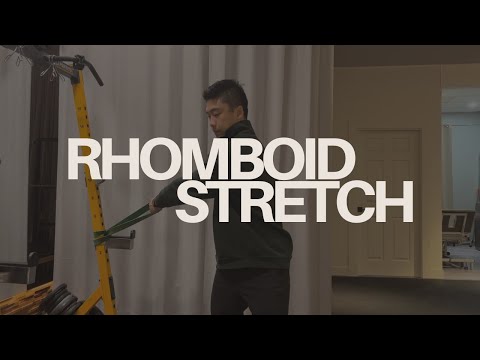
Rhomboid stretch
3 sets · 20 secStretches the muscles between the shoulder blades.
How to do it
1. Stand or sit tall and clasp your hands in front of you at chest height.
2. Push your hands forward and round your upper back, letting your shoulder blades spread apart.
3. Drop your chin slightly and breathe into the space between your shoulder blades.
4. Hold, then relax.
General advice for common aches, not a diagnosis. Move gently and within comfort. Stop if pain gets sharper or spreads, and see a physiotherapist if it hasn’t eased in a week or two.
Anatomy drawing: OpenStax, Tomáš Kebert and umimeto.org, adapted by Flexxo, CC BY-SA 4.0.
