
Exercises · Head & jaw
Tension headache
A dull, pressing ache like a tight band around the forehead, temples or back of the head, often with tight neck and shoulder muscles. It builds up with stress, poor sleep and long hours at a screen, and is usually worse later in the day. Easing the neck and shoulders and relaxing your breathing helps it settle and come back less often.
Where it hurts
- Frontalis · both sides
Forehead - Temporalis · both sides
Temple - Occipitalis · both sides
Back of the head - Splenius capitis · both sides
Back of the neck - Upper trapezius · both sides
Between the neck and shoulder
8 exercises, in this order
-
 1
Chin tuck
10 reps · 2 setsStrengthens the deep muscles at the front of the neck and eases strain at the base of the skull.
How to do it
1. Sit or stand tall with your shoulders relaxed and eyes looking straight ahead.
2. Gently slide your chin straight back, as if making a double chin. Keep your head level; don’t nod down.
3. Hold for 5 seconds, feeling a gentle stretch at the back of your neck.
4. Relax and repeat. -
 2
Upper trapezius stretch
3 sets · 30 secStretches the muscle between the neck and shoulder that tightens with stress and screen time.
How to do it
1. Sit tall and hold the edge of the chair with your right hand to keep that shoulder down.
2. Tilt your left ear towards your left shoulder until you feel a stretch on the right side of your neck.
3. For a little more stretch, rest your left hand on your head. Don’t pull.
4. Hold, then slowly come back to the middle and switch sides. -
 3
Levator scapulae stretch
3 sets · 30 secStretches the muscle that runs from the side of the neck to the top of the shoulder blade.
How to do it
1. Sit tall and hold the edge of the chair with your right hand.
2. Turn your head about 45° to the left, then look down towards your left armpit.
3. Rest your left hand on the back of your head and let its weight add a gentle stretch to the back right of your neck.
4. Hold, then switch sides. -
 4
Shoulder blade squeeze
10 reps · 3 setsStrengthens the muscles between the shoulder blades that hold the shoulders back and support the neck.
How to do it
1. Sit or stand tall with your arms relaxed by your sides.
2. Squeeze your shoulder blades back and down, as if tucking them into your back pockets.
3. Don’t shrug or arch your lower back. Hold for 5 seconds.
4. Relax slowly and repeat. -
 5
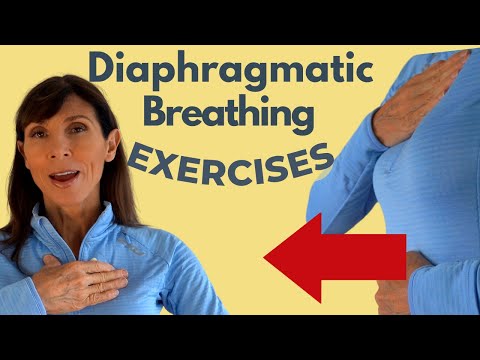
Diaphragmatic (belly) breathing
1 set · 5 minSlow breathing with the diaphragm relaxes tight neck, shoulder and chest muscles and calms pain.
How to do it
1. Lie on your back with knees bent, or sit comfortably. Put one hand on your chest and one on your stomach.
2. Breathe in slowly through your nose for about 4 seconds, letting your stomach rise. Your chest hand should barely move.
3. Breathe out gently through pursed lips for about 6 seconds, letting your stomach fall.
4. Keep your shoulders and jaw relaxed throughout. -
 6
Neck side bend stretch
3 sets · 20 secStretches the side of the neck and eases stiffness from sleeping awkwardly or long desk work.
How to do it
1. Sit or stand tall with your nose pointing straight ahead.
2. Slowly lower your right ear towards your right shoulder. Don’t lift the shoulder to meet it.
3. Hold where you feel a gentle stretch on the left side of your neck.
4. Come back to the middle and repeat on the other side. -
 7
Chin-to-chest stretch
3 sets · 20 secStretches the back of the neck and the base of the skull, where tension headaches often start.
How to do it
1. Sit tall with your shoulders relaxed.
2. Slowly lower your chin towards your chest until you feel a stretch at the back of your neck.
3. For a little more stretch, rest your hands on the back of your head and let their weight add to it. Don’t pull.
4. Hold, then slowly lift your head back up. -
 8
Scalene stretch
3 sets · 20 secStretches the muscles at the side and front of the neck that tighten with shallow breathing and stress.
How to do it
1. Sit tall and hold the edge of the chair with your right hand to anchor that shoulder.
2. Tilt your left ear towards your left shoulder.
3. Then turn your face slightly up towards the ceiling until you feel a stretch at the front and side of the right neck.
4. Hold, come back slowly and switch sides. Stop if you feel tingling in the arm.
General advice for common aches, not a diagnosis. Move gently and within comfort. Stop if pain gets sharper or spreads, and see a physiotherapist if it hasn’t eased in a week or two.
Anatomy drawing: OpenStax, Tomáš Kebert and umimeto.org, adapted by Flexxo, CC BY-SA 4.0.
