
Exercises · Lower back
Sciatica (pain down the leg)
Pain that travels from the lower back or buttock down the back of the leg, sometimes to the foot, often with tingling or numbness. It happens when a nerve in the lower back is irritated, usually by a disc. Leg pain often feels worse than back pain. Most sciatica improves within six to twelve weeks with gentle movement.
Where it hurts
- Thoracolumbar fascia
Lower back - Gluteus maximus · both sides
Buttock - Biceps femoris · both sides
Back of the thigh, outer side - Semitendinosus · both sides
Back of the thigh, middle
7 exercises, in this order
-
 1
Sciatic nerve glide
10 reps · 2 setsGently slides the sciatic nerve to ease pain and tingling down the leg.
How to do it
1. Sit tall on the edge of a chair.
2. Slowly straighten your painful leg while lifting your head to look up.
3. Then bend the knee back down while lowering your chin towards your chest.
4. Move smoothly between the two without holding. Stop if the leg symptoms get stronger. -
 2
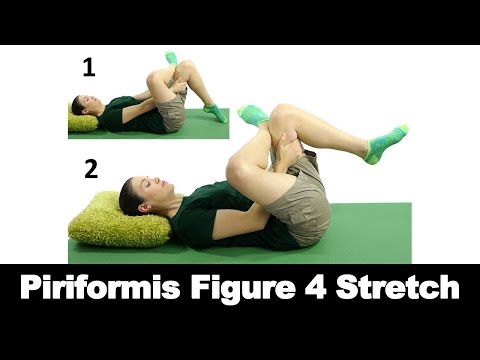
Figure-4 buttock stretch
3 sets · 30 secStretches the deep buttock muscles (including the piriformis) that can press on the sciatic nerve.
How to do it
1. Lie on your back with both knees bent.
2. Cross your right ankle over your left knee.
3. Hold behind your left thigh and gently pull it towards your chest until you feel a stretch in the right buttock.
4. Hold, then switch sides. -
 3
Lying press-up
10 reps · 1 setBends the lower back backwards, which often eases back and leg pain from a disc.
How to do it
1. Lie on your stomach with your hands under your shoulders.
2. Keeping your hips on the floor and your back relaxed, slowly push your upper body up with your arms.
3. Go as high as is comfortable and hold for 2 seconds, then lower slowly.
4. Good signs: pain moves towards the middle of your back. Stop if pain spreads further down the leg. -
 4
Knee to chest stretch
3 sets · 30 secGently stretches the lower back and buttock muscles.
How to do it
1. Lie on your back with both knees bent and feet flat.
2. Hold behind one knee and gently pull it towards your chest.
3. Keep the other foot on the floor and your lower back relaxed.
4. Hold, lower slowly and switch legs. -
 5
Bridge
10 reps · 3 setsStrengthens the buttocks and back muscles that support the lower back and hips.
How to do it
1. Lie on your back with your knees bent, feet flat and hip-width apart, arms by your sides.
2. Tighten your stomach and squeeze your buttocks.
3. Lift your hips until your body is in a straight line from shoulders to knees. Don’t arch your back.
4. Hold for 3 to 5 seconds, then lower slowly. -
 6
Lower trunk rotation
10 reps · 2 setsGently twists the lower back to ease stiffness.
How to do it
1. Lie on your back with your knees bent, feet flat and arms out to the sides.
2. Keeping your knees together and shoulders on the floor, slowly let both knees fall to one side.
3. Go only as far as is comfortable, then bring them back to the middle.
4. Repeat to the other side. -
 7
Kneeling hip flexor stretch
3 sets · 30 secStretches the front of the hip, which tightens with long periods of sitting.
How to do it
1. Kneel on your right knee (on a cushion) with your left foot flat in front, both knees at 90°.
2. Tuck your tailbone under and squeeze your right buttock.
3. Gently shift your weight forward until you feel a stretch at the front of the right hip. Keep your back upright.
4. Hold, then switch sides. Hold a chair for balance if needed.
General advice for common aches, not a diagnosis. Move gently and within comfort. Stop if pain gets sharper or spreads, and see a physiotherapist if it hasn’t eased in a week or two.
Anatomy drawing: OpenStax, Tomáš Kebert and umimeto.org, adapted by Flexxo, CC BY-SA 4.0.
