
Exercises · Shoulder
Frozen shoulder (stiff shoulder)
A shoulder that becomes painful and then very stiff, making it hard to lift the arm, reach behind your back or dress. It is more common between 40 and 60 and in people with diabetes, and can take months to settle. Regular gentle stretching keeps and slowly regains movement.
Where it hurts
- Anterior deltoid · both sides
Front of the shoulder - Posterior deltoid · both sides
Back of the shoulder
7 exercises, in this order
-
 1
Pendulum swing
2 sets · 1 minGently loosens a painful or stiff shoulder by letting gravity move the arm.
How to do it
1. Lean forward and rest your good hand on a table. Let your painful arm hang straight down, relaxed.
2. Gently rock your body so the arm swings forwards and backwards like a pendulum.
3. Then swing it side to side, then in small circles each way.
4. Let the arm stay floppy; the movement comes from your body, not your shoulder muscles. -
 2
Stick-assisted shoulder lift
10 reps · 2 setsLets your good arm help a stiff arm lift further than it can on its own.
How to do it
1. Lie on your back or sit tall, holding a stick or umbrella with both hands, shoulder-width apart.
2. Use your good arm to push the stick up and over your head, taking the stiff arm with it.
3. Go as far as is comfortable and hold for a few seconds.
4. Lower slowly and repeat. -
 3
Finger wall walk
10 reps · 1 setGradually regains how high you can lift a stiff shoulder.
How to do it
1. Stand facing a wall, about an arm’s length away.
2. Place the fingertips of your stiff arm on the wall at waist height.
3. Walk your fingers up the wall slowly until you feel a stretch. Step closer as you improve.
4. Hold for 10 seconds, then walk your fingers back down. Don’t shrug. -
 4
Towel stretch behind the back
10 reps · 1 setRegains reaching behind your back, for tucking in a shirt or fastening clothes.
How to do it
1. Hold a towel over one shoulder with your good hand, letting it hang down your back.
2. Reach behind your back with your stiff arm and grab the other end.
3. Gently pull the towel upwards with your good arm to lift the stiff hand up your back.
4. Hold, then lower slowly. -
 5
Cross-body shoulder stretch
3 sets · 30 secStretches the back of the shoulder, which often tightens with shoulder pain.
How to do it
1. Stand or sit tall and bring your painful arm across your chest at shoulder height.
2. Use your other hand above the elbow to gently pull it closer to your chest.
3. Keep your shoulder down, away from your ear.
4. Hold where you feel a stretch at the back of the shoulder. -
 6
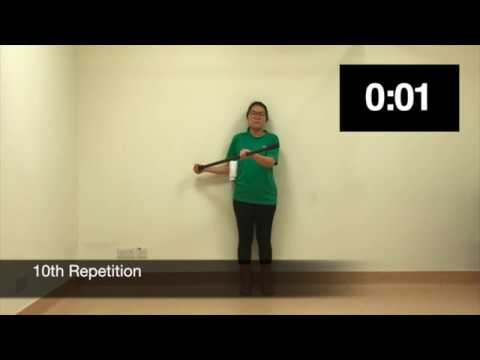
Stick-assisted outward rotation stretch
10 reps · 2 setsUses the good arm to turn a stiff shoulder outwards, the movement frozen shoulders lose first.
How to do it
1. Sit or lie on your back with your elbows tucked into your sides and bent to 90°, holding a stick in both hands.
2. Use your good arm to push the stick across, turning the stiff arm’s forearm outwards.
3. Keep the stiff elbow tucked in against your side.
4. Hold where you feel a stretch, then return. -
 7
Sleeper stretch
3 sets · 30 secStretches the back of the shoulder joint to restore turning the arm inwards.
How to do it
1. Lie on your painful side with a pillow under your head and that arm out in front at shoulder height, elbow bent to 90°, fingers pointing up.
2. Roll your body back slightly so your weight isn’t directly on the shoulder.
3. With your other hand, gently push the forearm down towards the bed until you feel a stretch at the back of the shoulder.
4. Hold, then release. It should be a stretch, never a pinch at the front.
General advice for common aches, not a diagnosis. Move gently and within comfort. Stop if pain gets sharper or spreads, and see a physiotherapist if it hasn’t eased in a week or two.
Anatomy drawing: OpenStax, Tomáš Kebert and umimeto.org, adapted by Flexxo, CC BY-SA 4.0.
